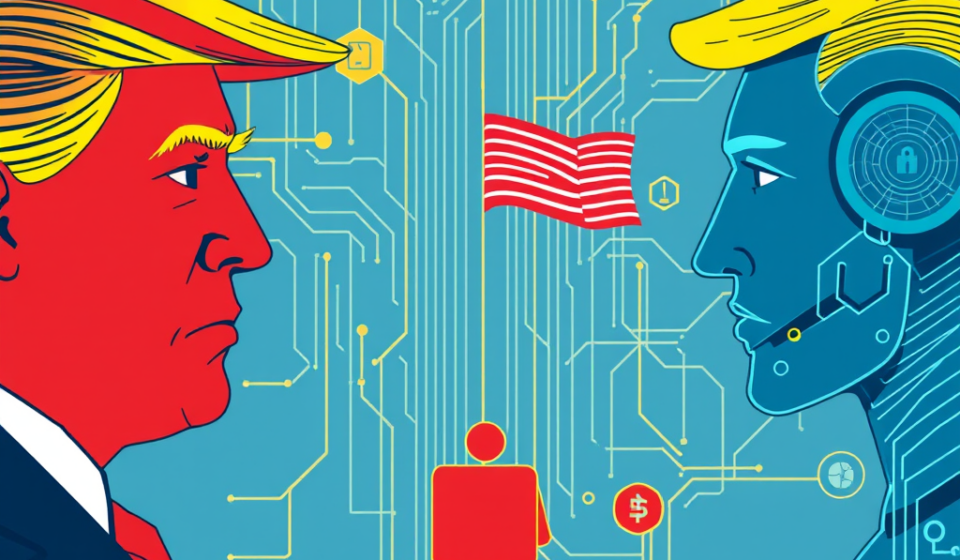

The recent Trump tech giants AI accord establishes a voluntary framework for artificial intelligence safety among industry leaders. In this comprehensive analysis, we examine what this agreement means for corporate IT infrastructure, national security, and enterprise risk management programs worldwide.
Modern artificial intelligence development moves at a blistering pace. Industry titans race to deploy generative models while policymakers scramble to draft guardrails. Recently, a major milestone emerged as political leadership and Silicon Valley titans forged a voluntary framework. This development alters the landscape of Cyber Security and digital governance permanently.
Trump Tech Giants AI Accord: Strategic Overview
Corporate compliance meets geopolitical strategy in this new agreement. Understanding the mechanics of this pact requires looking at infrastructure demands and risk mitigation.
The Core Pillars of the Trump Tech Giants AI Accord
Voluntary frameworks often spark debate among security practitioners. Critics argue that lack of enforcement weakens risk posture. Proponents maintain that flexibility encourages rapid innovation without stifling growth. Security teams must evaluate how these guidelines impact their Incident Response plans. Major technology firms agreed to share telemetry data regarding model anomalies. Such data sharing accelerates threat intelligence dissemination across competing organizations. Infrastructure engineers gain better visibility into potential supply chain vectors.
Balancing Innovation and Risk Mitigation
Balancing rapid deployment with rigorous testing remains a primary challenge. AI workloads demand immense computational power and cooling capacity. Securing these environments requires strict adherence to zero-trust principles. Organizations must monitor model drift and adversarial manipulation attempts constantly. Enterprise security architects implement robust guardrails around training datasets. These measures prevent unauthorized data exfiltration and intellectual property theft.
Operational Impact on Enterprise IT Infrastructure
Adopting voluntary safety measures influences daily operations significantly. IT departments face new compliance burdens and monitoring requirements. Hardware procurement strategies also shift toward trusted vendors and secure supply chains.
Hardware Security and Supply Chain Resilience
Hardware integrity forms the bedrock of secure artificial intelligence deployments. Specialized accelerators and GPUs represent high-value targets for threat actors. Facilities housing these clusters require multi-layered physical and logical security controls. According to reports from Dark Reading, industry leaders commit to rigorous hardware vetting procedures. Supply chain visibility reduces the risk of malicious firmware implants.
Software Guardrails and Red Teaming Protocols
Software vulnerabilities in neural networks differ fundamentally from traditional code flaws. Adversarial machine learning attacks exploit mathematical quirks rather than memory bugs. Comprehensive red teaming exercises uncover hidden blind spots before deployment. Security teams simulate sophisticated extraction and evasion attacks regularly. Continuous auditing ensures that models operate within predefined ethical and operational boundaries.
Future Outlook for AI Governance and Compliance
Regulatory landscapes will evolve rapidly following this landmark agreement. Enterprise leaders must stay ahead of emerging compliance mandates globally. Strategic foresight separates resilient organizations from vulnerable competitors.
Preparing Your Security Operations Center
Security Operations Center teams need specialized training in machine learning security. Traditional SIEM tools often miss subtle anomalies within neural network outputs. Analysts must learn to recognize poisoned training data and prompt injection vectors. Integrating AI-specific telemetry into existing security monitoring pipelines is crucial. Proactive threat hunting prevents catastrophic security failures before they manifest.
Conclusion and Strategic Recommendations
The Trump tech giants AI accord signals a new era of collaborative risk management. Organizations must review their internal policies and adopt these voluntary safety baselines immediately. Prioritize robust red teaming, hardware vetting, and continuous model monitoring to safeguard enterprise assets.